


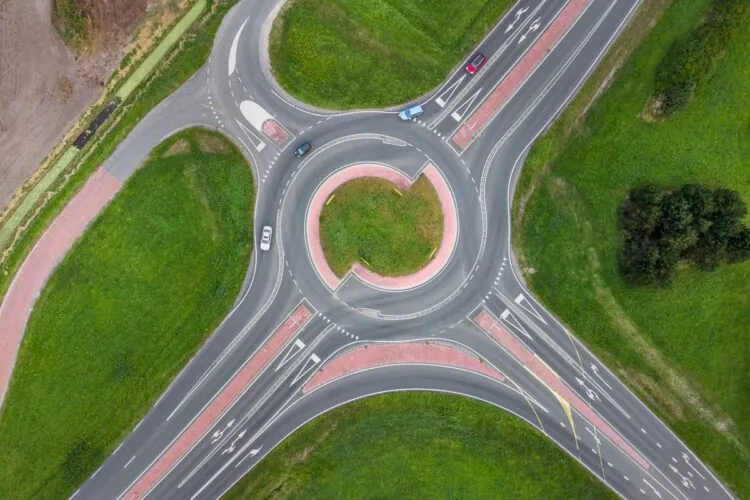
Turbine roundabout: how is it different from a normal roundabout? How to drive?
Rondo turbinowe – czym jest i jak prawidłowo jeździć?
Roundabouts have become an integral part of Polish roads, but not all are created equal. More and more frequently, we come across the turbine roundabout, which poses quite a challenge for many drivers. Although this type of intersection is supposed to increase capacity and safety, many people do not know how to navigate a roundabout properly. In this article, we will explain what a turbine roundabout is, how it differs from a normal roundabout and how to drive around it to avoid collisions.

Need a car for a few days? Slawa Rent in Wadowice hires out cars, 9-seater minibuses and vans, with delivery available in Krakow and the surrounding area. Cars from 80 PLN per day for longer rentals.
Visit the car hireWhat is a turbine roundabout?
A turbine roundabout is a special type of intersection with circular traffic, which was designed to increase safety and traffic flow. The first turbine roundabout was developed in the Netherlands in the 1990s, and since then the solution has spread to many European countries, including Poland.
Główną cechą charakterystyczną ronda turbinowego jest fizyczne oddzielenie pasów ruchu za pomocą specjalnych linii i często podwyższonych krawężników, które tworzą tzw. „turbinę”. Dzięki temu kierowca wjeżdżający na rondo turbinowe musi wcześniej zająć odpowiedni pas ruchu, zgodny z planowanym kierunkiem jazdy, a następnie poruszać się po rondzie zgodnie z wyznaczonymi torami bez możliwości dowolnej zmiany pasa.
How does the turbine roundabout work?
In a turbine roundabout, traffic is organised in such a way as to completely exclude the need to change lanes on the roundabout, which significantly reduces the risk of collisions. Each entrance to a turbine roundabout is usually equipped with two lanes, and the driver must decide which lane to take before entering the roundabout, depending on which exit he or she wants to use to leave the roundabout.
This system eliminates conflicting points of intersection between vehicle tracks, making traffic on a turbine roundabout virtually collision-free. Traffic flows are physically separated from each other, forcing drivers to behave appropriately and eliminating unnecessary manoeuvres.
Turbine roundabout appearance
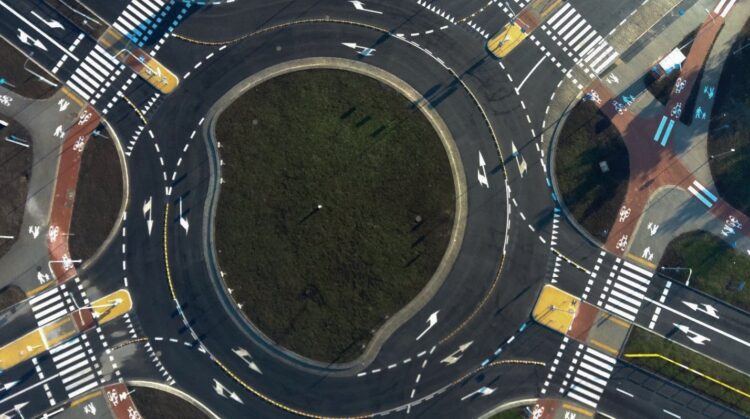
A turbine roundabout can be recognised by its characteristic arrangement of lanes, which resemble the shape of a turbine (hence the name). It usually consists of two lanes at each inlet and outlet, with the lanes clearly separated from each other by:
- Continuous lines (horizontal sign P-4)
- Elevated separators
- Raised kerbs
- Special horizontal and vertical markings
Na rondzie turbinowym znajduje się znak C-12 „ruch okrężny” wraz z tabliczką informującą o typie ronda. Dodatkowo, przed wjazdem na rondo turbinowe, kierowcy napotkają znaki pionowe informujące o konieczności zajęcia odpowiedniego pasa ruchu w zależności od planowanego kierunku jazdy.
How is a turbine roundabout different from a regular roundabout?
Classic roundabouts and turbine roundabouts have several key differences that affect the way they are navigated:
1. possibility of changing lanes
In normal roundabouts, drivers can change lanes as they drive around the roundabout, which often leads to dangerous situations and collisions. In a turbine roundabout, lane changes are physically prevented by special separators or continuous lines.
2. take the appropriate lane before entering
Before entering a turbine roundabout, the driver must take the correct lane, closely related to the intended direction of travel. At ordinary roundabouts, such a requirement is not so strictly enforced.
3. priority crossing
In a turbine roundabout, priority is given to vehicles already in the roundabout, just as in normal roundabouts. However, due to the physical separation of the lanes, situations where the driver has to give way to vehicles in another lane are minimised.
4 Capacity
Turbine roundabouts have a higher capacity than conventional roundabouts. Studies show that a turbine roundabout can handle up to 35% more vehicles per unit time than a conventional roundabout of the same size.
5 Safety
Due to the physical separation of lanes and the elimination of conflict points, turbine roundabouts are statistically safer than normal roundabouts. The risk of collisions is significantly reduced because drivers cannot cross their paths.
How to drive around a turbine roundabout?
Navigating a turbine roundabout requires slightly different habits than driving on a normal roundabout. Here is a step-by-step guide on how to drive correctly in a turbine roundabout:
1. before you enter the roundabout
Before entering the turbine roundabout you should:
- Take note on vertical signs indicating the lane layout
- Take the appropriate lane depending on the intended direction of travel:
- Prawy pas – jeśli chcesz skręcić w prawo lub jechać na wprost
- Lewy pas – jeśli chcesz jechać na wprost lub skręcić w lewo (albo zawracać)
- Switch on your indicator in the direction you want to exit the roundabout
- Slow down and prepare to give way to vehicles already on the roundabout
2. entering the turbine roundabout
Drivers entering a turbine roundabout must give way to vehicles already on the roundabout. Please note that:
- You cannot change your lane choice decision when entering a roundabout
- Follow the designated lane for the lane occupied
- Do not cross continuous lines or physical obstructions separating lanes of traffic
3. navigating roundabouts
Once you are at the turbine roundabout:
- Utrzymuj się na swoim pasie ruchu – nie możesz go zmienić!
- Observe horizontal signs indicating the direction of travel
- Keep a safe distance from other vehicles
- Turn on your right indicator before you exit the roundabout (this does not apply to the first exit, in which case the right indicator should already be on when you enter the roundabout)
4. exit from the roundabout
To exit the turbine roundabout correctly:
- Turn on your right indicator well in advance of the exit
- Slow down before the descent to negotiate the curve safely
- Pay attention to pedestrians and cyclists at crosswalks near the exit
- Nie zatrzymuj się gwałtownie na rondzie, aby ustąpić pierwszeństwa pieszym – lepiej zwolnić wcześniej
Examples of manoeuvring on a roundabout
Turn right (first exit)
- Take the right lane before entering the roundabout
- Turn on the right indicator
- Give way to vehicles on the roundabout
- Enter the roundabout in the right-hand lane
- Take the first exit from the roundabout, remaining in the right-hand lane
Driving straight (second exit)
- You can take the right or left lane (depending on the signage)
- When entering a roundabout, do not use your indicator or use your left signal
- Give way to vehicles on the roundabout
- Enter the roundabout in the correct lane
- Before exiting, switch on your right indicator
- Take the second exit from the roundabout, remaining in your lane
Left turn (third exit)
- Take the left lane before entering the roundabout
- Turn on your left indicator
- Give way to vehicles on the roundabout
- Enter the roundabout in the left lane
- Stay in the left lane
- Before exiting, switch on your right indicator
- Take the third exit from the roundabout
Turning around (last exit)
- Take the left lane before entering the roundabout
- Turn on your left indicator
- Give way to vehicles on the roundabout
- Enter the roundabout in the left lane
- Stay in the left lane at all times
- Before the last exit, switch on your right indicator
- Take the last exit from the roundabout
The most common mistakes made by drivers at turbine roundabouts
Many collisions at turbine roundabouts are due to a failure to follow basic rules. Here are the most common mistakes:
- Attempting to change lanes on a roundabout – na rondzie turbinowym jest to fizycznie niemożliwe i próby takie zwykle kończą się uszkodzeniem pojazdu lub kolizją
- Taking the wrong lane before entering – wybór pasa niezgodnego z planowanym kierunkiem jazdy
- Forced priority – niezastosowanie się do znaku „ustąp pierwszeństwa” przy wjeździe na rondo
- Failure to signal intention to exit – nieużywanie kierunkowskazu przy opuszczaniu ronda
- Stopping at roundabouts – blokowanie ruchu przez niepotrzebne zatrzymywanie się
Turbine roundabouts in Poland
The first roundabout in Poland was built in Katowice in 2006. Since then, the number of such intersections in our country has been steadily increasing. Today, turbine roundabouts can be found in many Polish cities, including Warsaw, Krakow, Poznań, Wrocław, Łódź, Szczecin and many others.
Polskie przepisy ruchu drogowego nie zawierają szczegółowych regulacji dotyczących wyłącznie rond turbinowych – obowiązują ogólne zasady dotyczące skrzyżowań o ruchu okrężnym, z uwzględnieniem specyficznego oznakowania danego ronda.
Benefits of turbine roundabouts
Turbine roundabouts have many advantages over classic roundabouts:
- Increased throughput – mogą obsłużyć większy ruch pojazdów
- Reduced risk of collision – dzięki fizycznemu rozdzieleniu pasów ruchu
- Reduction of collision points – z 16 na zwykłym rondzie do 10 na rondzie turbinowym
- Lower vehicle speeds – co przekłada się na bezpieczeństwo
- Better traffic organisation – kierowcy są „prowadzeni” przez rondo dzięki wyraźnemu oznakowaniu
- Reduction congestion – płynniejszy ruch oznacza mniej korków
Summary - how to navigate a turbine roundabout?
To drive safely around a turbine roundabout, remember these key rules:
- Before entering the roundabout, take the appropriate lane according to your intended direction of travel
- It is not possible to change lanes at a turbine roundabout
- Give way to vehicles already on the roundabout
- Comply with vertical and horizontal markings
- Turn on your right indicator before exiting the roundabout
- Take extra care when exiting the roundabout, paying attention to pedestrians and cyclists
The turbine roundabout, although it may seem complicated at first, is in fact designed to make it easier for drivers to navigate roundabout intersections. By enforcing certain behaviours, it eliminates many of the dangerous situations typical of ordinary roundabouts. Once you learn the rules of driving in a turbine roundabout, you will appreciate its advantages and the safety it provides.
Remember that the key to driving safely around a turbine roundabout is to plan ahead and decide your direction before entering the junction. Once you enter the roundabout, you must follow the designated lane, with no opportunity to change lanes.
By following these rules, you will navigate turbine roundabouts safely and smoothly, contributing to the overall improvement of traffic flow.
Need a car for a trip? Slawa Rent car hire: see cars and prices.