



What to take with you to Croatia when travelling by car – car equipment, documents and vignettes
When travelling to Croatia by car, take your ID card or passport, driving licence, vehicle registration certificate and third-party liability insurance policy with you, and keep high-visibility vests, a warning triangle, a first-aid kit and spare bulbs – these are required by Croatian regulations for passenger cars. On top of this, you’ll need to purchase vignettes in transit countries (the Czech Republic, Slovakia, Austria, Hungary and Slovenia) and pay tolls on Croatian motorways, which are charged per section travelled.
Compulsory car equipment in Croatia
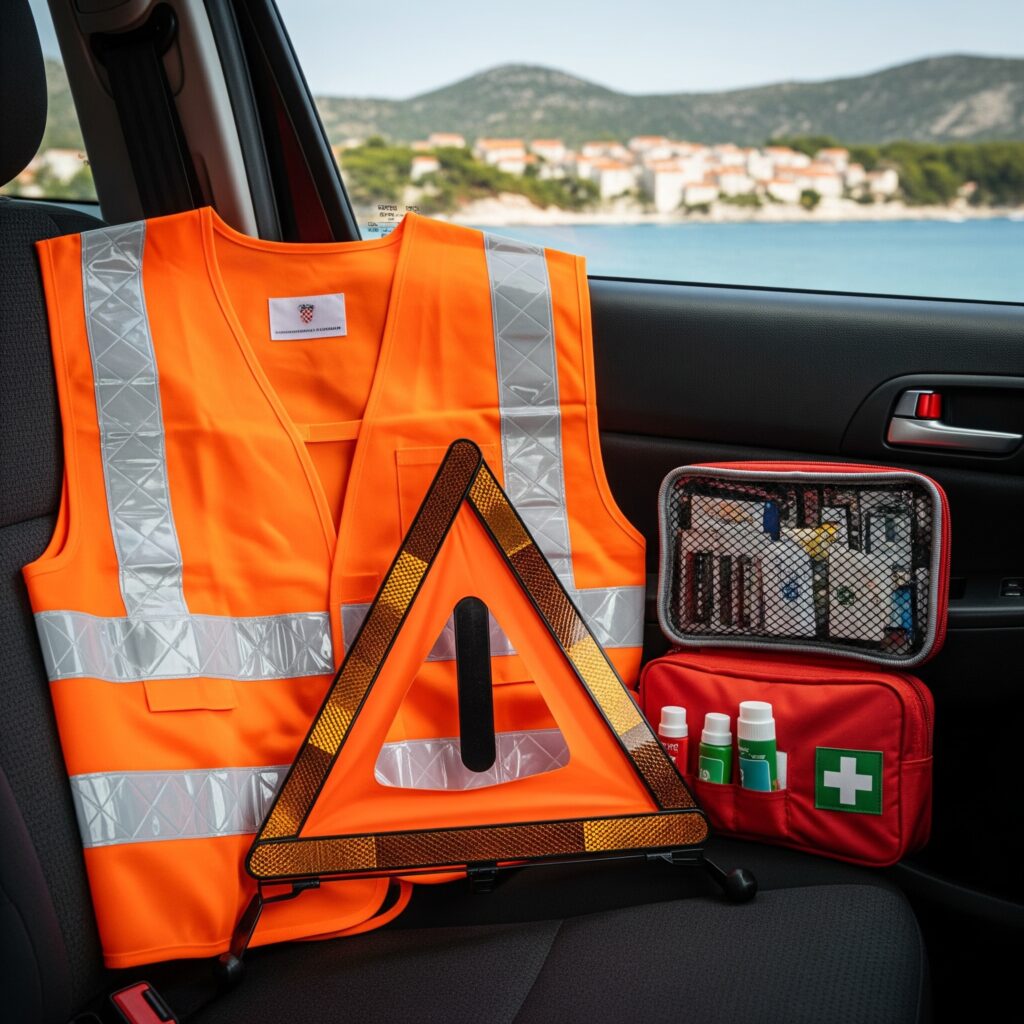
The Croatian Ministry of the Interior (MUP) sets out the equipment that a passenger car must have. The legal basis for this is the Road Traffic Safety Act and the Regulation on the Technical Conditions of Vehicles (NN 85/16, as amended).
| Equipment | What do the Croatian regulations say? |
|---|---|
| Warning triangle | 1 unit, in accordance with ECE R 27 regulations (2 warning triangles only when used in conjunction with a trailer on buses and lorries) |
| First-aid kit | 1 first-aid kit |
| High-visibility vest | The driver must wear it when carrying out tasks on the road involving the car (e.g. changing a tyre, setting up a warning triangle) |
| Spare bulbs | a set covering at least half of the lights; this does not apply to cars with LED or xenon lighting |
| Spare wheel | required, unless the car has run-flat tyres or a repair kit (spray, foam) |
The Croatian Automobile Club (HAK) advises that there should be a high-visibility vest for every person in the car, and that the warning triangle and first-aid kit should be kept within easy reach, not under the luggage. On the motorway, if you break down, you should put on your high-visibility vest first, then get out of the car.
Does a Polish car have to have Croatian fittings?
Formally, a car registered in Poland should comply with Polish requirements, i.e. it must carry a fire extinguisher and a warning triangle. However, the Croatian kit (high-visibility vests, first-aid kit, spare bulbs) doesn’t cost much and saves you from any arguments during a roadside check, so the simplest option is to carry everything listed in the table above. Leave the fire extinguisher in the car – it’s compulsory in Poland.
Equipment checklist before setting off
- reflective vests for everyone, stored in the cabin,
- a warning triangle and a fire extinguisher,
- first-aid kit (check the expiry dates of the dressings),
- spare bulbs, if the car has conventional headlights,
- a spare wheel or a repair kit and a jack,
- child seats or booster seats tailored to the child’s height and weight.
Documents required in Croatia
Croatia is a member of the European Union and the Schengen Area, and from 2023, the euro will be the currency used there. A valid identity card or passport is all you need – this also applies to children, who must have their own travel document.
- driving licence – a Polish one is accepted; an international one is not required,
- car registration certificate,
- third-party liability insurance – valid in the EU without a green card,
- for a hire car or company car: the hire agreement or the owner’s written consent to travel abroad,
- an EHIC card (issued by the National Health Fund) and travel insurance covering medical expenses.
Vignettes and road tolls in 2026
The most common routes are via the Czech Republic and Austria (then on to Slovenia) or via Slovakia and Hungary. In each of these countries, motorways require an electronic vignette, which is linked to the vehicle’s registration number. Buy them on the operators’ official websites – intermediaries add a service charge.
| Country | Short-term vignette (passenger car) | Official sale |
|---|---|---|
| Czech Republic | 1 day 230 CZK, 10 days 300 CZK, 30 days 480 CZK | edalnice.gov.cz |
| Austria | 1 day €9.60, 10 days €12.80, 2 months €32 | asfinag.at |
| Slovakia | 1 day €8.10, 10 days €10.80, 30 days €17.10 | eznamka.sk |
| Hungary | e-vignette: check the current rate | nemzetiutdij.hu |
| Slovenia | e-vignette: check the current rate | evinjeta.dars.si |
Prices for the Czech Republic and Austria are taken from the official price lists for 2026. The Slovak rates are provided by the eznamka.sk website – please check that they haven’t changed before making a purchase.
Motorways in Croatia
There is no vignette in Croatia. You pay for the section of motorway you have travelled on (e.g. the A1 Zagreb–Split). Croatia is switching to a barrier-free system, in which the toll is calculated based on a reading of your number plate or via an ENC device. The date for the full roll-out has been postponed, so before you set off, check the HAC motorway operator’s website to see how tolls are currently being paid.
Preparing the car for the journey
It’s over 1,000 km from southern Poland to Dalmatia, and it’s often very hot. Before you set off, check:
- tyre pressure and tread depth, including the spare tyre (when the vehicle is fully laden, the pressure may be higher – this is indicated on a sticker on the door or fuel filler flap),
- oil, coolant and brake fluid levels,
- how the air conditioning works,
- all the lights,
- the date of the roadworthiness test – it must remain valid for the duration of the journey (more in the post How long can you drive without an MOT?).
Whether on the roof or on a bike rack, your load must not obstruct the lights or the number plate. Pack heavy items low down on the boot floor so that they do not fly into the passenger compartment when you brake.
What to take with you to Croatia – apart from your car
For the journey
- water and snacks for a dozen or so hours’ drive,
- car charger and power bank,
- offline maps on your mobile (signal can be poor in the mountains),
- a payment card and some cash in euros for car parks and small purchases,
- activities for children on a long journey.
To the venue
- sun cream with a high SPF, sunglasses, a hat,
- water shoes – many beaches are stony, and there are sea urchins near the shore,
- a light jumper for the evening and in case it gets windy,
- your own medicines, including painkillers, anti-allergy medicines and medicines for stomach problems,
- a snorkelling mask, if you’re planning to swim near the rocks.
The sockets in Croatia are the same as in Poland (230 V), so you don’t need an adapter.
By hire car to Croatia
If you’re travelling in a larger group or with a lot of luggage, you can take one car instead of two 9-seater minibus, which you drive with a Category B driving licence. At Slawa Rent, you must notify us of any trips abroad when making your booking – we will confirm the terms and conditions for the specific car. The website sets out the deposit, excess and refuelling rules terms and conditions of hire. Book via the form on the website or by calling 787 001 003.
Frequently Asked Questions
What equipment is compulsory in a car in Croatia?
According to Croatian regulations: a warning triangle, a first-aid kit, a high-visibility vest, spare bulbs (except for cars with LED or xenon lights) and a spare wheel or a tyre repair kit. It is a good idea to have a high-visibility vest for each passenger.
Is an ID card sufficient for travelling to Croatia?
Yes. Croatia is a member of the EU and the Schengen Area, so Polish citizens can enter the country with a valid identity card. Children must have their own identity card or passport.
Is there a vignette in Croatia?
No. In Croatia, you pay for the section of motorway you travel on. You buy vignettes in the transit countries: the Czech Republic, Austria, Slovakia, Hungary or Slovenia.
Do I need a Green Card?
No. A Polish third-party liability insurance policy is valid throughout the European Union, including in Croatia and any other countries you travel through.
Can I drive a hire car to Croatia?
It depends on the car hire company and the car. At Slawa Rent, you need to let us know if you’re travelling abroad when you make your booking, and we’ll confirm the terms and conditions for the car you’ve chosen.
Are you planning a trip in a hire car? Take a look car and minibus hire for a trip to Croatia – route, charges, regulations and prices.