

A road trip around Europe – where to go and how to plan your route
If you’re setting off on holiday by car from southern Poland, the easiest destinations to reach are the Czech Republic, Slovakia, Austria, Hungary, Croatia and northern Italy – you can get to these places in 1–2 days’ driving. Plan your route through Europe so that you cover 400–500 km a day, including stops, and check in advance where you’ll need a vignette and where you’ll pay at toll booths. Below you’ll find destinations, vignette prices for 2026 and a checklist of things to check before you set off.
Where to go on a driving holiday in Europe
The choice of route depends mainly on how many days you want to spend travelling. From Małopolska, the neighbouring countries are the closest, whilst more distant destinations are best broken down into stages with overnight stops along the way.
| Field of study | What to see | How many days on site? | Road tolls |
|---|---|---|---|
| Czech Republic | Prague, Karlovy Vary, Bohemian Paradise, Karlštejn Castle | 2-4 | e-vignette |
| Slovakia | The High Tatras, Spiš Castle, Bratislava, thermal baths | 3-4 | e-vignette |
| Austria | Vienna, Salzburg, Hallstatt, Tyrol, the Grossglockner Road | 4-6 | vignette + tolls for certain Alpine roads |
| Hungary | Budapest, Lake Balaton, Eger, Hévíz | 4-6 | e-vignette |
| Croatia | Plitvice Lakes, Split, Dubrovnik, the islands | 7-10 | motorway toll booths |
| Italy | Venice, Lake Garda, Tuscany, Rome | 7-14 | motorway toll gates, ZTL zones in towns and cities |
| Germany | Berlin, the Rhine Valley, Bavaria, the Bavarian Alps | 5-7 | toll-free motorways for passenger cars |
| France | Provence, the Côte d’Azur, the French Alps | 10-14 | motorway toll booths |
The Czech Republic and Slovakia – for a short break
Prague, Karlovy Vary or the Slovak Tatra Mountains are all great destinations for a long weekend. In Slovakia, it’s worth combining a trip to the mountains with a visit to the thermal spas (e.g. Bešeňová, Tatralandia) and Spiš Castle. You’ll find more ideas for places right by the border in this round-up Slovakian attractions near Poland.
Austria and Hungary – cities, the Alps and thermal spas
To get to Vienna, you travel through the Czech Republic, and from there you can head towards Salzburg and Tyrol. Hungary offers Budapest with its thermal baths, Lake Balaton and the thermal lake at Hévíz – a great destination for families.
Croatia and Italy – a trip to the seaside
Croatia is a classic destination for a road trip: the route takes you through Slovakia and Hungary, or via the Czech Republic, Austria and Slovenia. The most common route to Italy is via Austria. In the centres of Italian cities, there are ZTL (restricted traffic) zones – entering without a permit will result in a fine sent by post, so park outside the zone.
Germany and France – longer routes
The Rhine Valley, Bavaria and the Bavarian Alps are good destinations for a week. The south of France (Provence, Nice, Cannes) requires a two-day journey each way, so plan for at least 10–14 days. For long-haul destinations, such as Portugal or Greece, it’s often better value to fly and hire a car once you arrive.
How to plan a road trip around Europe
- Choose a destination and 2–3 places along the way that you really want to see.
- Work out the stages: 400–500 km a day is a distance you can cover with breaks and still have time to see the sights. Stop for a break roughly every 2 hours.
- Check which countries you’ll be travelling through and buy your vignettes online before you set off (see the table below).
- In July and August, book your accommodation in advance and check whether they have parking – this is often a problem in city centres.
- Download offline maps in case you lose signal, and check for roadworks along your route.
- Leave a day’s leeway in case your plans change, the weather turns, or you decide to stay longer somewhere.
The smallest crowds and the lowest accommodation prices are in May, June and September. During the peak season, set off early in the morning and check the traffic conditions on your sat-nav before crossing borders and driving through major cities.
How much does a car journey cost?
Include the following in your budget: fuel (car’s fuel consumption × journey length × fuel price in the country in question), vignettes and motorway tolls, city car parks, accommodation and food. With four people, the cost of fuel and vignettes is shared amongst everyone, and there are no luggage limits – compare this amount with the cost of tickets for the whole family.
Vignettes and road tolls in Europe (2026)
In countries with a vignette system, you pay for a period of time rather than per kilometre. Most vignettes are now electronic – you buy them online using your registration number, without a sticker. Only buy them from the operators’ official websites: intermediaries add a commission.
| Country | The shortest vignette | Monthly / 2-monthly | Annual | Where to buy |
|---|---|---|---|---|
| Czech Republic | 1 day 230 CZK, 10 days 300 CZK | 30 days 480 CZK | 2,570 CZK | edalnice.gov.cz |
| Slovakia | 1 day: €8.10, 10 days: €10.80 | 30 days €17.10 | 90 EUR | eznamka.sk |
| Austria | 1 day: €9.60, 10 days: €12.80 | 2 months, 32 EUR | 106.80 EUR | asfinag.at |
| Hungary | 1 day 5,550 HUF, 10 days 6,900 HUF | month 11,170 HUF | 61,760 HUF | nemzetiutdij.hu |
| Slovenia | 16 EUR per week | per month 32 EUR | 117.50 EUR | evinjeta.dars.si |
The prices apply to passenger cars weighing up to 3.5 tonnes with petrol or diesel engines. In the Czech Republic, natural gas, plug-in hybrid and electric cars are subject to lower rates or are exempt (electric cars with foreign registration must be declared). Current Czech price list: edalnice.gov.cz, Austrian: asfinag.at.
Countries with toll gates and no tolls
- Croatia, Italy, France, Spain, Portugal – you pay for the section of motorway you’ve travelled on, usually at the toll booths (cash or card).
- Austria – Apart from the vignette, there are separate charges for certain roads and tunnels, such as the Grossglockner Road.
- Germany – Motorways are free of charge for passenger cars.
Documents and equipment before departure
Documents
- An identity card or passport – within the EU, an identity card is sufficient.
- Polish driving licences – recognised throughout the EU.
- Vehicle registration certificate and proof of third-party liability insurance. Third-party liability insurance is valid within the EU; when entering countries outside the EU, check whether you need a Green Card.
- European Health Insurance Card (EHIC).
- Joint accident report form – makes it easier to report a minor collision whilst abroad.
Condition of the car and equipment
Before setting off, check your tyres (tread and pressure when fully loaded), oil, fluids, lights, windscreen wipers and air conditioning. Keep a warning triangle, first-aid kit, high-visibility vests and a spare tyre or repair kit in the car. Equipment requirements vary from country to country (e.g. high-visibility vests for passengers, a fire extinguisher, snow chains in the mountains during winter) – check the requirements for each country on your route before setting off.
Car hire for a trip abroad
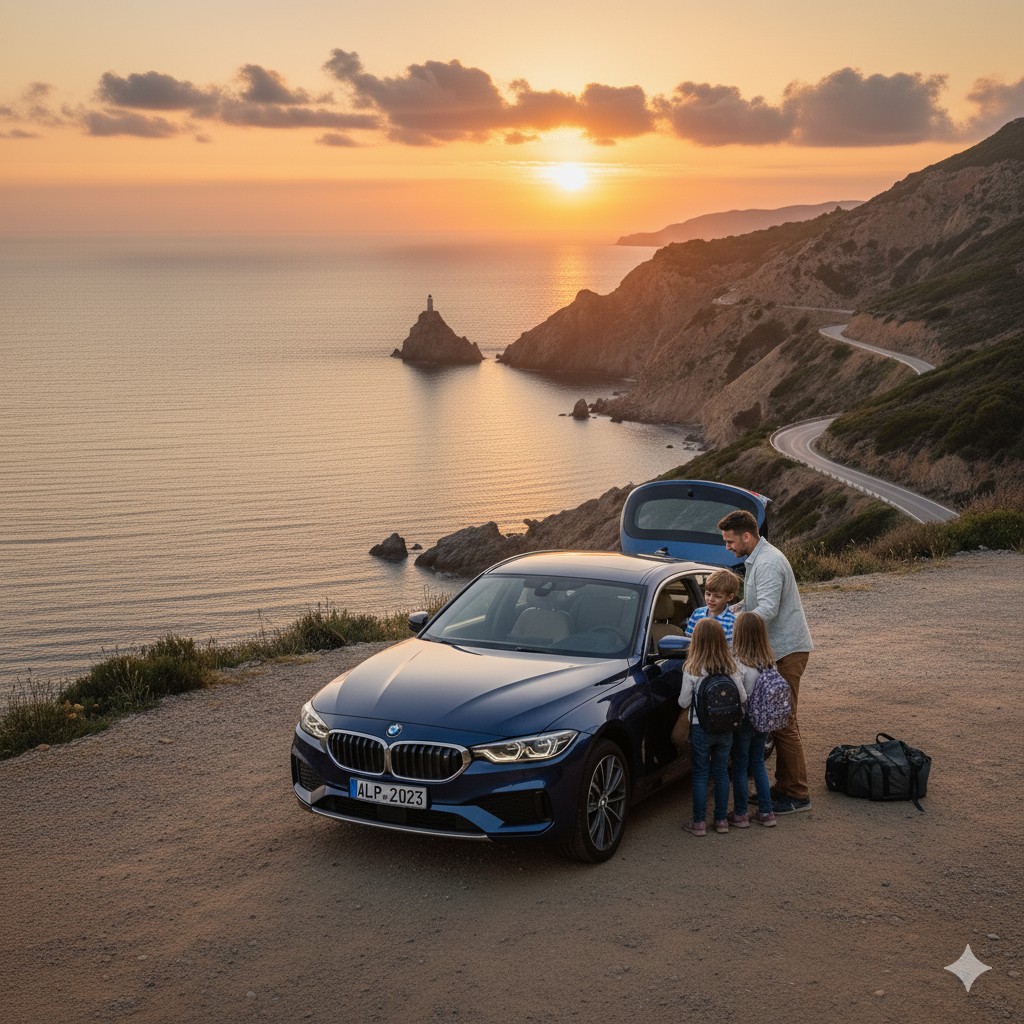
If you don’t have a car or don’t want to drive thousands of kilometres in your own, you can hire a car for the duration of your holiday. When hiring a car for a trip abroad, bear three things in mind:
- Please specify your travel dates when booking and specify the countries on the route – the car hire company will confirm the terms and conditions for the specific car.
- Check your mileage allowance As stated in the contract, the journey to Croatia and back is several thousand kilometres.
- Enquire about vignettes and fuel – You buy the vignettes yourself using the registration number of the hire car, and you usually return the car with the same amount of fuel as when you collected it.
At Slawa Rent in Wadowice, you can hire a car or an SUV (e.g. a Peugeot 3008) or 9-seater minibus for a trip with a larger group. Please let us know when booking if you’re travelling abroad – we’ll confirm the terms and conditions for your chosen car. Daily rates decrease for longer hire periods – see price list i terms and conditions of hire (deposit, fuel, documents).
Frequently Asked Questions
How many kilometres should you drive each day whilst on holiday?
You can comfortably cover 400–500 km a day, taking breaks roughly every two hours. You could cover more, but that leaves less time for sightseeing, and tiredness increases the risk on the road.
Do you need to buy a vignette in Germany?
No. German motorways are free for passenger cars. However, you will need to buy a vignette in the Czech Republic and Austria, through which the route often passes.
Where can I buy a vignette for the Czech Republic, Slovakia and Austria?
Online via the official websites: edalnice.gov.cz, eznamka.sk and asfinag.at. The vignette is linked to the registration number, so there is no need to stick anything on the windscreen.
Can you drive a hire car abroad?
Yes, provided you notify the car hire company before you set off. At Slawa Rent, you specify the countries when making your booking, and we confirm the terms and conditions for the specific car.
Is a Polish driving licence valid throughout Europe?
In European Union countries, yes. An international driving licence may be required in some non-EU countries.