


Changing gears in a car – at what speed and revs?
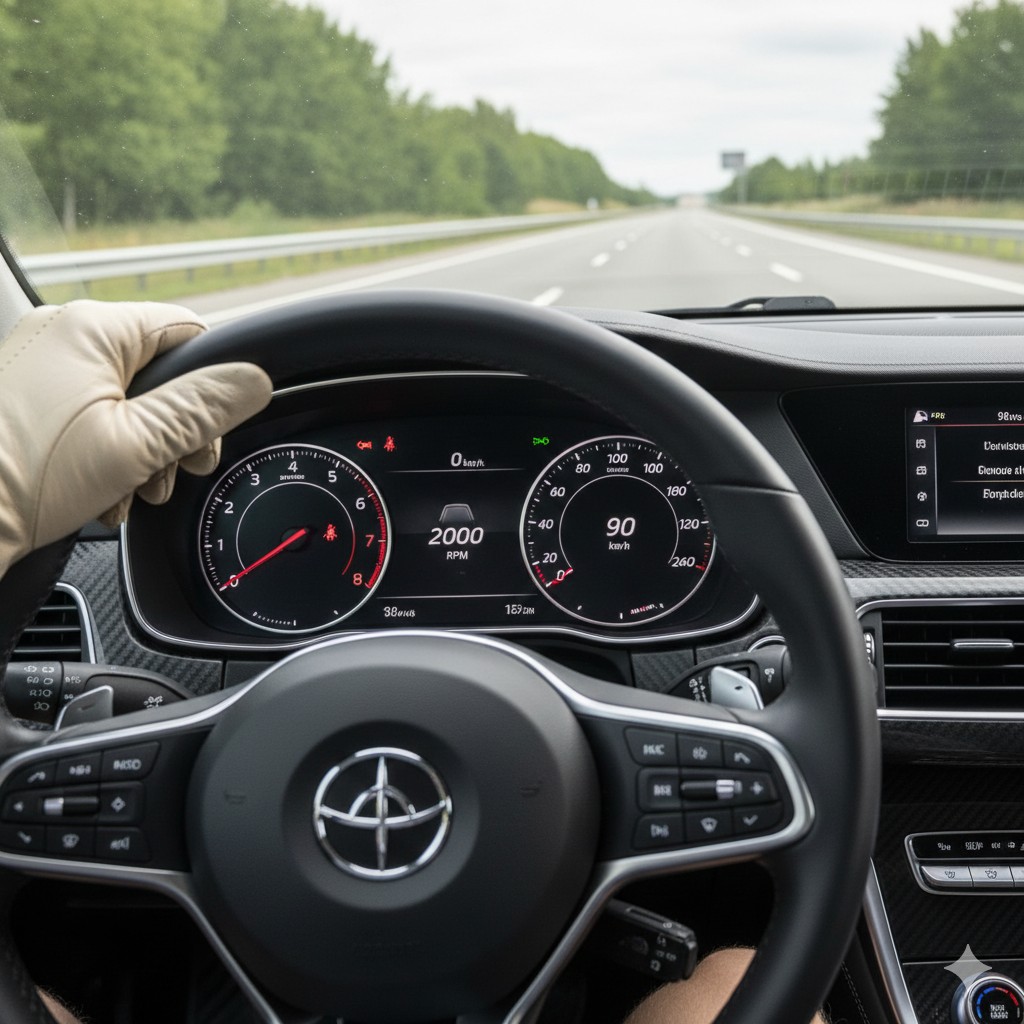
In a car with a manual gearbox, gear changes are mainly based on engine revs rather than a fixed speed. When driving at a steady pace, a higher gear is usually selected at around 2,000–2,500 rpm for petrol engines and around 1,700–2,000 rpm for diesel engines, which in a typical passenger car gives the following approximate figures: second gear at 15–20 km/h, third gear at 30–35 km/h, fourth gear at 45–50 km/h, fifth gear at 60–70 km/h, and sixth gear above 80 km/h.
Which gear for which speed – table
The figures below apply to a typical passenger car with a 5- or 6-speed gearbox driven at a moderate pace. Gear ratios vary between models, and a minibus or van carrying a load requires higher revs, so please treat the table as a starting point.
| Run | Approximate speed range | When to switch to a higher-octane fuel (petrol / diesel) |
|---|---|---|
| 1 | 0–20 km/h (starting off, manoeuvring) | after a few metres, at 10–20 km/h |
| 2 | 15–40 km/h | approx. 30–35 km/h |
| 3 | 30–60 km/h | approx. 45–55 km/h |
| 4 | 45–80 km/h | approx. 60–70 km/h |
| 5 | from around 60 km/h upwards | in a 6-speed gearbox, approx. 80–90 km/h |
| 6 | from around 80 km/h upwards (main road, motorway) | - |
In practice, in town at 50 km/h you usually drive in third or fourth gear; on a national road at 90 km/h in fifth or sixth gear; and on the motorway in top gear.
At what revs should you change gear?
Petrol engine
When driving calmly, change up a gear at around 2,000–2,500 rpm. When you need strong acceleration (joining traffic, overtaking), you can go up to 3,000–4,000 rpm. Newer turbo engines deliver plenty of power even at low revs, so you can change gear earlier with them.
Diesel engine
A diesel engine delivers most of its power at lower revs, which is why you usually shift up to a higher gear at around 1,700–2,000 rpm. Revving a diesel engine above 3,000–3,500 rpm rarely achieves anything other than higher fuel consumption.
Too low revs are also harmful
If, after changing gear, the revs drop below around 1,200–1,500 rpm and the car starts to shake and refuses to accelerate, you’re in too high a gear. Driving at a snail’s pace puts a strain on the clutch, the dual-mass flywheel and the crankshaft assembly, and you’ll still have to change down when you try to accelerate. It’s better to shift down a gear.
Gear-change indicator and hearing
Most newer cars have an arrow on the dashboard to indicate when to change gear. It’s set for fuel efficiency, so when the car is fully loaded or going uphill, you can change gear later than it suggests. If your car doesn’t have a rev counter or a gear indicator, listen to the engine: when it starts to whine noticeably, it’s time to shift up; when it hums and shakes, it’s time to shift down.
How to change up a gear correctly
- Take your foot off the accelerator and, at the same time, press the clutch all the way down.
- Shift the gear lever into the next gear with a smooth motion, without jerking.
- Release the clutch smoothly whilst gently pressing the accelerator at the same time.
You don’t always have to go through every gear in turn. When accelerating gently on a flat stretch, you can, for example, shift straight from third into fifth, provided the revs don’t drop too low after the change.
Downshifting – when to change to a lower gear
Downshifting means changing to a lower gear, e.g. from fifth to fourth. It provides more power to the wheels and allows you to use engine braking. Downshift when:
- The car loses speed going uphill and the revs drop – change down a gear before the engine starts to shake,
- if you want to overtake – shifting down from fifth to fourth (or from sixth to fourth) gives you much more responsive acceleration,
- When approaching a bend or junction – first apply the brakes, then change to a lower gear,
- When you’re driving down a long hill, use a lower gear to use engine braking and take the strain off the brakes.
A step-by-step guide to reduction
- Take your foot off the accelerator and, if necessary, apply the brakes.
- When your speed drops to the lower gear range, press the clutch.
- Change to a lower gear (you can skip a gear – for example, from fifth to third – if the speed is right).
- Release the clutch smoothly. If there’s a significant difference in revs, give it a little more throttle so the car doesn’t jerk.
A traffic calming measure before a bend and a junction – an example
You’re driving at 70 km/h in fifth gear and you need to turn left at the junction:
- Take your foot off the accelerator and start braking well in advance.
- When your speed drops to around 30–40 km/h, press the clutch and shift into third gear (or second gear if the bend is very tight).
- Release the clutch before entering the bend, and take the bend with the accelerator pressed down slightly.
General rule: change gear on a straight stretch of road, before a bend. In the bend itself, concentrate on steering – changing gear whilst cornering can affect the car’s stability, particularly on wet or slippery surfaces. Sharp bends are usually taken in second or third gear, whilst gentle bends are taken in third or fourth gear.
Engine braking – when and how
Engine braking is the process of slowing down whilst in gear without pressing the accelerator. The engine creates resistance, the car loses speed, and the brakes do not overheat. It comes in handy:
- on long downhill stretches in the mountains – stay in the same gear that you’d use to climb that hill,
- on a slippery surface – slowing down gradually is better than sudden braking,
- In a traffic jam and when approaching traffic lights – simply take your foot off the accelerator in good time.
Downshift gradually, one gear at a time, and do not let the revs drop into the red zone on the rev counter. Do not coast downhill in neutral or with the clutch depressed – you’ll lose engine braking, and the brakes will overheat more quickly.
The most common errors when changing gears
- Speed reduction when travelling too fast – For example, shifting into second gear at 80 km/h causes the engine to rev beyond the permitted limit and may damage it. Slow down first, then change down.
- For releasing the clutch too quickly – the car jerks, and the clutch wears out more quickly.
- Keeping your hand on the gear lever and your foot on the clutch – accelerates wear and tear on the gear-changing mechanisms and the thrust bearing.
- Driving in too high a gear – the engine ‘stalls’ at low revs, and the car is slow to respond to the accelerator.
- Changing gear whilst cornering – compromises stability, particularly on a slippery road.
Gears in a car with an automatic gearbox
In an automatic gearbox, the gearbox selects the gear automatically based on speed and load. Manual mode (M, +/- or the paddles on the steering wheel) is mainly useful on long downhill stretches to use engine braking. We describe the differences between manual, automatic, DSG and CVT gearboxes in our guide types of gearboxes and in the text about continuously variable transmission (CVT).
Frequently Asked Questions
At what speed should you change into 5th gear?
In a typical passenger car, you change into fifth gear at around 60–70 km/h. If, after changing gear, the revs drop below around 1,500 rpm and the car is struggling to accelerate, stay in fourth gear for a little while longer.
What’s the speed in 4th gear?
Fourth gear is usually suitable for speeds of around 45–80 km/h. In town, at 50 km/h, it’s often a good choice if the engine is running smoothly and isn’t shaking.
Which gear should you use to drive at 50 km/h?
Usually in third or fourth gear. In third gear, the car responds better to the accelerator; in fourth gear, it uses less fuel.
Why does the car jerk when changing gear?
This is most often caused by releasing the clutch too quickly or a large difference in revs when changing down a gear. If the car jerks despite using a smooth technique, the cause may be a worn clutch or engine mounts.
Is it okay to skip a run?
Yes. When accelerating or changing down, you can skip a gear (e.g. from fifth to third) if your speed matches the gear you’re shifting into.
Do you need a car for a trip or for work? In Slawa Rent’s range In Wadowice, there are passenger cars, 9-seater minibuses that can be driven with a Category B driving licence, and delivery vans.