



Changing gears in a car – at what speed and revs?
The correct gear-changing technique is essential for smooth, economical and safe driving. Many drivers, particularly beginners, wonder: when exactly should you change gear? At what speed and engine revs? In this article, we’ll explain the principles of correct upshifting and downshifting so that you can drive confidently and economically.
Changing up a gear – when should you change to a higher gear?
Optimal revs for each gear
Petrol engines:
- 1→2nd gear: around 15–20 km/h (2,000–2,500 rpm)
- 2nd→3rd gear: around 30–40 km/h (2,500–3,000 rpm)
- 3rd to 4th gear: around 50–60 km/h (2,500–3,000 rpm)
- 4th→5th gear: around 70–80 km/h (2,500–3,000 rpm)
Diesel engines:
- 1→2nd gear: around 15–20 km/h (1,500–2,000 rpm)
- 2nd→3rd gear: around 30–35 km/h (1,800–2,200 rpm)
- 3rd to 4th gear: approximately 45–55 km/h (1,800–2,200 rpm)
- 4th→5th gear: approximately 65–75 km/h (1,800–2,200 rpm)
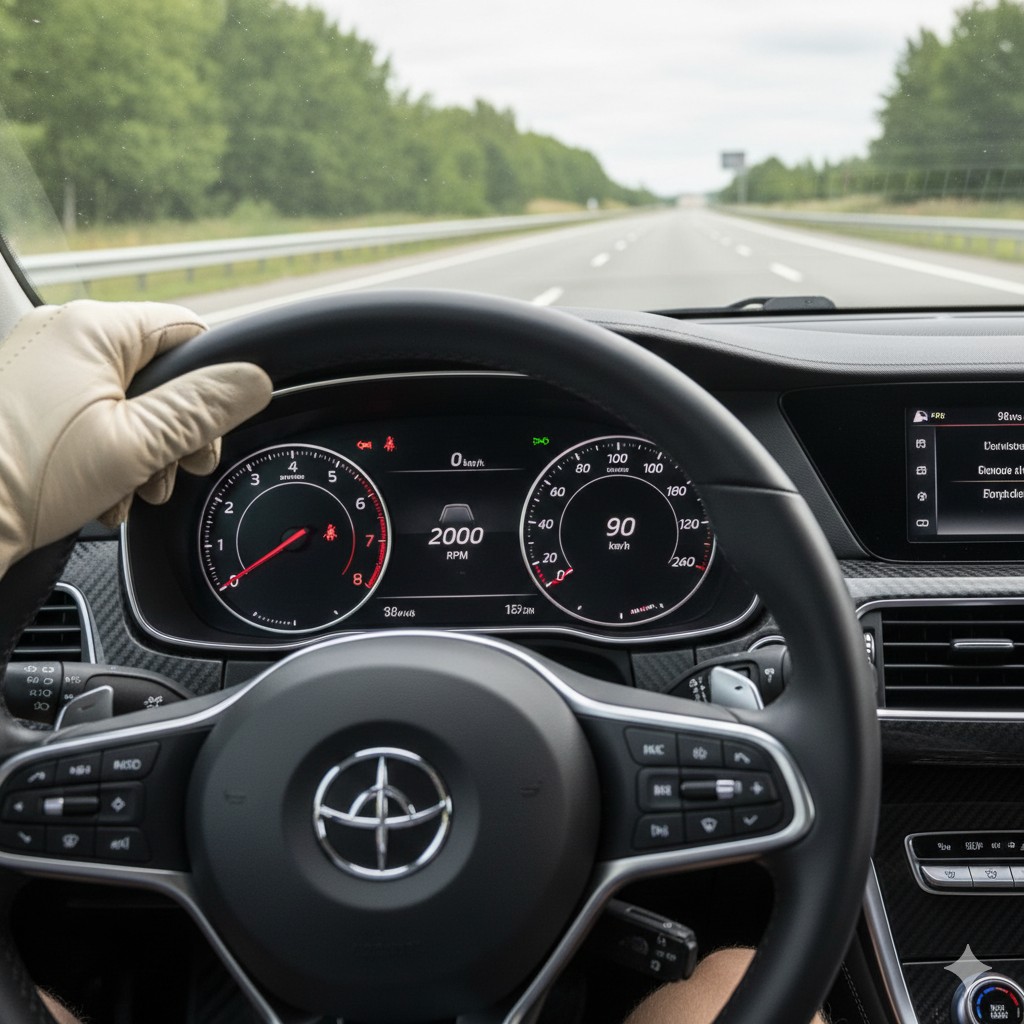
General principle: Change gear when the engine reaches around 2,000–3,000 revolutions per minute (petrol) or 1,500–2,000 rpm (diesel). Avoid excessively high revs (above 4,000) – this wastes fuel and puts unnecessary strain on the engine.
Listen to the engine
Doświadczeni kierowcy często zmieniają biegi „na słuch”. Gdy silnik zaczyna pracować głośniej, brzęczeć lub „wibrować” – to znak, że czas na wyższy bieg. Nowoczesne cars they also have indicator gear changes on the dashboard, which suggests the optimum time to change gear.
Downshifting – what is it and when should you do it?
Downshifting means changing to a lower gear, for example, from the fifth to the fourth or from the third to the second. It is used to to increase the engine’s driving force and engine braking.
When should we change down a gear?
Before driving uphill: If you feel the car losing power on a hill, change down a gear (e.g. from 5th to 4th or from 4th to 3rd). A lower gear provides more torque, which makes it easier to climb hills.
When overtaking: Do you need to accelerate quickly? Shift down a gear (e.g. from 5th to 4th) to make the most of the engine’s power. Acceleration is slower and less dynamic in a higher gear.
Before the bend: Slowing down before a bend is a key technique for safe driving. Change down a gear before you enter the bend, when you’re driving in a straight line. When going round a bend, focus on steering, not on changing gears.
When engine braking: Instead of constantly using the brakes (especially on long downhill stretches), make use of engine braking by changing down a gear. This preserves the brake pads and prevents the brakes from overheating.
Before the junction: When slowing down before a junction (e.g. from 70 to 30 km/h), first apply the brakes, then change to the appropriate gear (e.g. from 5th to 3rd or 2nd).
The correct technique for changing down a gear
Step by step
1. Take your foot off the accelerator – let the engine slow down naturally 2. Press the clutch all the way down – completely disconnect the engine from the gearbox 3. Change to a lower gear – smooth, confident lever operation 4. Gradually release the clutch – gently, to avoid a sudden jerk 5. Accelerate (if necessary) – stabilise the engine speed
The most common mistakes
Speed reduction when the revs are too high: Jeśli zredukujesz bieg, gdy silnik pracuje na wysokich obrotach (np. przełączysz z 5 na 2 przy 80 km/h), silnik gwałtownie „wyje” do czerwonego pola. To może uszkodzić silnik! Slow down first, then shift down.
Releasing the clutch too quickly: Releasing the clutch too abruptly after downshifting causes a jolt, discomfort for passengers and wear and tear on the clutch. Always release the clutch smoothly.
Downshift in the middle of a bend: Changing gear whilst cornering compromises the car’s stability and may cause it to skid. Always slow down before a bend, not whilst going round it.
Skipping gears unnecessarily: You don’t need to change each gear in turn. You can safely skip a gear (e.g. from 5th to 3rd) if your speed and revs allow it.
A traffic calming measure before a junction – a practical example
You’re driving at 70 km/h in fifth gear and approaching a junction where you need to turn left.
Step 1 (100 m before): Take your foot off the accelerator and start braking Step 2 (50 m before): Continue braking; your speed drops to 40 km/h Step 3 (30 metres before): Press the clutch and change down from 5th to 3rd gear Step 4 (20 m ahead): Speed 30 km/h, release the clutch, ready to turn Step 5 (turn): You take bends smoothly, in the right gear and with good control
Rule: Use the brakes (not the engine!) to slow down, and change down once your speed has dropped to a level suitable for a lower gear.
Slowing down before a bend – a safe driving technique
A beginner’s mistake: He enters the bend in a high gear (e.g. 5th), and in the middle of the bend tries to brake and change down at the same time – the car becomes unstable.
Correct technique:
Phase 1 – Before the bend (when travelling in a straight line):
- Rate the bend (sharp? gentle?)
- Brake until you reach the correct speed
- Shift down to the appropriate gear (sharp bend = 2nd–3rd gear, gentle bend = 3rd–4th gear)
Phase 2 – On a bend:
- Don’t brake! (unless you have to)
- Don’t change gear!
- Just concentrate on driving and staying on course
- You can gently press the accelerator to stabilise the car
Phase 3 – Exiting a bend:
- Straighten the handlebars
- Step on the gas
- Increase your pace (if necessary)
Engine braking – when and how?
Engine braking This involves using the engine’s resistance to slow the vehicle down by driving in a lower gear without pressing the accelerator.
When should it be used?
- Long downhill runs – prevents the brakes from overheating
- Slippery surface – safer than sudden braking
- Fuel savings – you make use of kinetic energy rather than wasting it on the brakes
- Speed control – maintaining a constant, low speed (e.g. in a traffic jam)
How do you do it properly?
- Take your foot off the accelerator
- Drop down one or two gears (no more!)
- Let the engine slow the vehicle down naturally
- Only use the brakes when you need to come to a complete stop
Important: Do not coast in neutral (N) or with the clutch depressed! It is dangerous – you lose control of the car and the ability to brake using the engine.
Summary – the golden rules of gear-changing
✓ Change up a gear at 2,000–3,000 rpm (petrol) or 1,500–2,000 rpm (diesel) ✓ Reduce smoothly – slow down first, then change gear ✓ Listen to the engine – will teach you how to change gears intuitively ✓ Slow down before the bend, not whilst going round it – safety first ✓ Use engine braking on long descents ✓ Avoid running the engine at too high a revs – save fuel and protect your engine ✓ Keep an eye on the indicators – modern cars suggest the best time to do so
The correct gear-changing technique is the key to comfortable, economical and safe driving. Over time, it will become second nature – just like it does for any experienced driver!
Frequently asked questions about changing gears
Why does the car jerk when changing gear?
This is usually caused by releasing the clutch too quickly, or by the engine revs being too low or too high when changing gear. Release the clutch smoothly whilst gently pressing the accelerator at the same time. If the jerking occurs despite driving smoothly, the cause may be a worn-out clutch or engine mounts, and it’s worth taking the car to a mechanic.
What are the signs of a worn-out clutch?
Typical signs include: the engine revs rise but the car accelerates poorly; the clutch engages at a very high rev; the gears are stiff to change; and there is a burnt smell when accelerating hard.
Do you need to think about gear changes in a car with an automatic gearbox?
Not normally. The gearbox selects the gear automatically. On long downhill stretches in the mountains, however, it’s worth using manual mode or a lower gear to use engine braking and avoid overheating the brakes.
Planning a long journey? Hire a reliable car at Slawa Rent and enjoy a smooth, comfortable ride!
Slawa Rent – Your Sure Path!