



When you face a fine for not having lights - regulations and penalties
Proper vehicle lighting is not only a safety issue, but also a legal obligation. Polish legislation regulates in detail when a driver must use lights, and failure to do so can result in a fine and penalty points.
Basic duty to use lights
Driving at night
Regardless of the time of year and weather conditions, drivers are absolutely obliged to use their position and dipped headlights between dusk and dawn. Driving at night without lights is one of the most serious traffic offences.
Conditions of reduced visibility
During rain, snow, fog, thunderstorms or other atmospheric phenomena reducing visibility below 200 metres, the use of dipped headlights is mandatory regardless of the time of day.
Daytime built-up area
Since 2007 drivers are obliged to drive with lights on all year round in a built-up area. This applies to daytime driving between dawn and dusk when visibility is good.
Expressways
On motorways and motorways, there is a year-round obligation to use lights 24 hours a day, regardless of weather and visibility conditions.
Amount of fine for no lights
Standard rates
The fine for driving without the required lights is 100 zloty and involves receiving 2 penalty points. This is one of the more frequently imposed penalties by the traffic police.
Driving at night without lights
Za jazdę w nocy bez świateł mandat może być wyższy – nawet do 300 złotych wraz z 4 penalty pointsif it poses a particular risk to road safety.
Incorrect lighting
Using the wrong type of lights (e.g. traffic lights in the city) can result in with a fine of PLN 200 and 4 penalty points for blinding other drivers.
Types of lights and their use
Position lights
Small position lights are used to indicate the dimensions of a vehicle. They are used at night in combination with dipped-beam headlights and also when the vehicle is stationary on the road after dusk.
Dipped beams
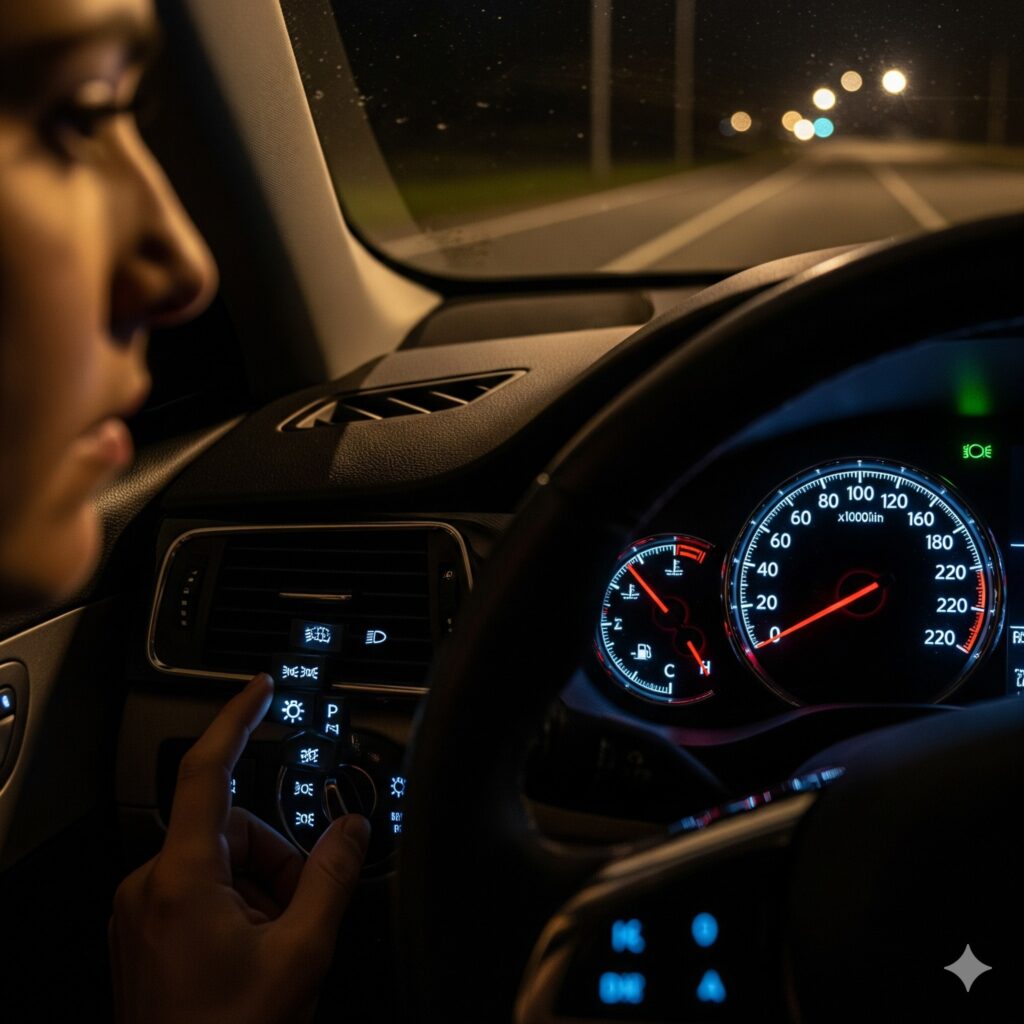
These are the primary lights used when driving. They have a range of approximately 40 metres and are mandatory at night, in reduced visibility and during the day in built-up areas and on expressways.
Traffic lights
Traffic lights with a range of more than 100 metres can only be used outside built-up areas when there is no opposing or preceding traffic. In urban areas, their use is prohibited.
Fog lamps
Rear fog lights must only be switched on when visibility is less than 50 metres. Their unnecessary use may result in a fine for blinding other drivers.
Special situations
Two-wheelers
Motorbikes, mopeds and scooters are required to ride with their lights on all year round, 24 hours a day, regardless of weather conditions or where they are riding.
Emergency vehicles
Vehicles of the emergency services, police or fire brigade may use light signals in accordance with separate regulationsHowever, the basic lighting obligation still applies.
Work vehicles
Agricultural tractors, construction machinery and other slow-moving vehicles operating on public roads have specific lighting and marking requirements.
Police checks
The most common inspection sites
The police especially frequently control the use of lights at entrances to cities, in tunnels, during bad weather conditions and in the morning and evening hours.
Automatic detection
Some monitoring systems can automatically detect vehicles driving without lights in areas where this is mandatory. Developments in technology are making enforcement more effective.
Procedure for the imposition of a fine
The officer stops the vehicle, checks the documents and finds that the required lights are missing. A fine may be imposed on the spot or the driver may receive a summons to pay the fine.
Modern lighting systems
Automatic switching of lights
Many modern cars has a system to automatically switch on the lights depending on the lighting conditions. However, the driver is still responsible for the proper operation of the system.
LED daytime running lights
Dedicated LED daytime running lights (DRL) meet the requirements of daytime lighting regulations. They are energy efficient and increase vehicle visibility.
Light adapters
Adaptive systems automatically adjust the angle and range of the lights according to speed and driving conditions, improving safety and comfort.
Practical tips for drivers
Regular checking
It is a good idea to check the operation of all lights before every drive. A burnt-out bulb can result in a fine, even if the driver was not aware of it.
Headlight cleaning
Dirty headlamps significantly reduce the effectiveness of the lighting. Regularly cleaning your headlamps improves visibility and can save you from a fine for insufficient lighting.
Knowledge of legislation
It is a good idea to be familiar with lighting regulations, especially when travelling to other countries where different regulations may apply.
Slawa Rent - efficient lighting
Pre-hire inspection
At Slawa Rent in Wadowice Every vehicle undergoes an inspection of all lighting systems before it is hired. We check the operation of the low beam, high beam, position lights and signals.
Instructions for customers
When handing over the car, we inform customers of the location of the light switches and remind them of their duties in relation to lighting the vehicle in different conditions.
Immediate reaction to fault
In the event of a lighting failure during a rental, we ensure that the vehicle is replaced quickly or repaired immediately so that the customer does not risk a fine.
Modern systems
Our fleet includes vehicles equipped with automatic lighting systems and LED daytime running lights, increasing safety and facilitating compliance.
Seasonal aspects of lighting
Autumn and winter
During autumn and winter, when the days are shorter and weather conditions often change, it is particularly important to comply with lighting regulations.
Time change
Once the clocks have been reset to winter or summer time, it is a good idea to note on the changing dawn and dusk hours, which affect the obligation to use lights.
Compliance with lighting regulations is the basis for safe driving and avoiding fines. Knowing the rules and regularly checking the condition of your lights allows you to travel in comfort and safety.
Slawa Rent – Wypożyczalnia Cars
Wadowice
Nasze samochody – zawsze sprawne oświetlenie!